Your neighbour knocks: “The tree on your lot is cracking the shared wall.” A responsible reply asks who will inspect, when, what they’ll do if risk is high, how to appeal if the fix fails, and what you owe if a fix is late.¶ 1 (permalink to paragraph 1)
Listening without acting is theatre. Acting without limits is arbitrary. Responsibility turns recognition into engagement with teeth: published promises you can verify, contest and revoke. They still need authority and remedies before they bind.¶ 2 (permalink to paragraph 2)
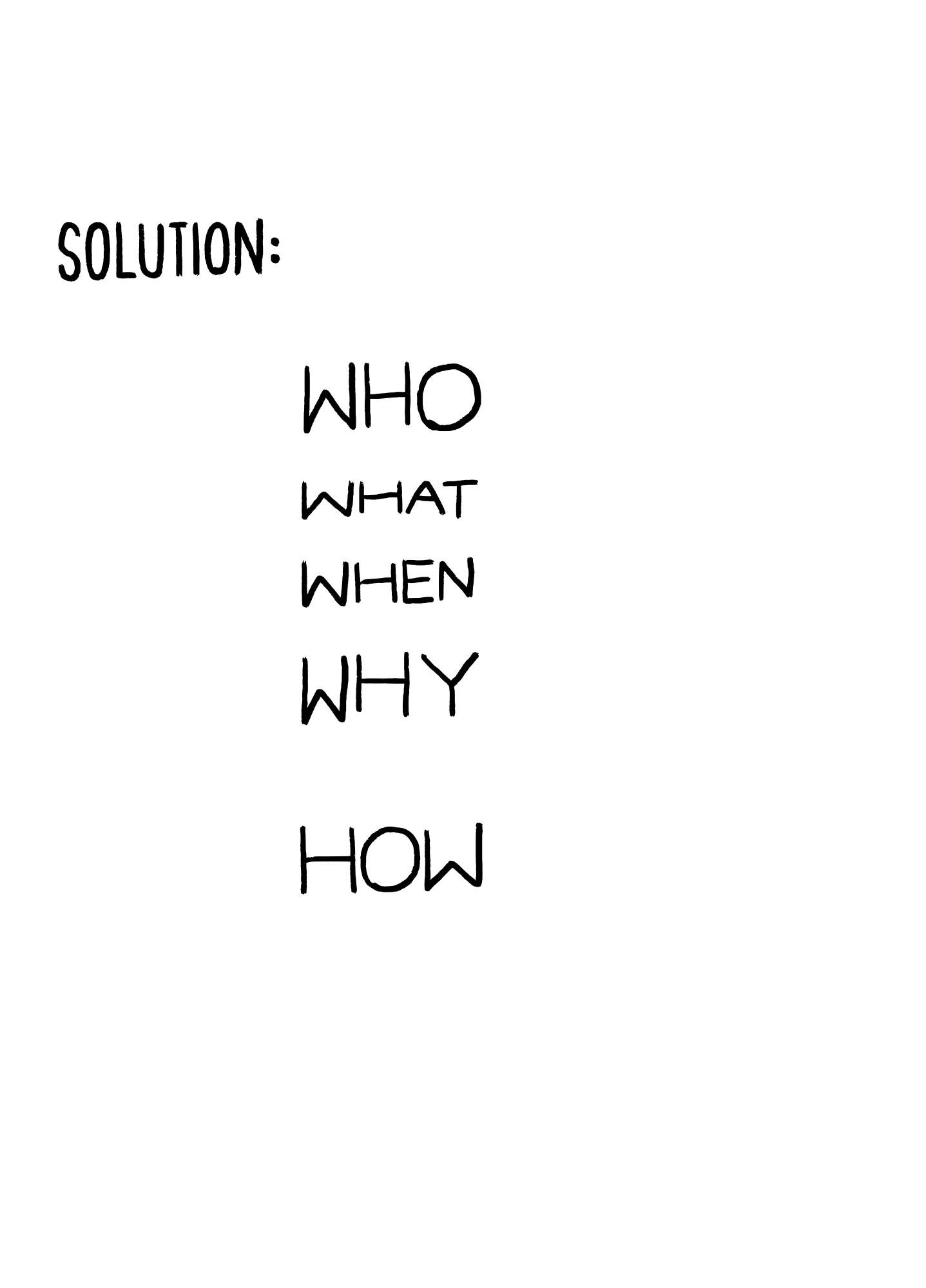
In Moral Boundaries, Joan Tronto elevates responsibility as the most politically central phase of care, and in Caring Democracy (p. 46) she reframes democratic politics itself. Harold Lasswell’s 1936 formula, as Tronto quotes it, was “who gets what, when and how”. Tronto’s version is “who is responsible for caring for what, when, where, and how.” The shift replaces a distributive frame (who wins the allocation contest) with a relational one: who has made a binding commitment, to whom, and how do we know if they have kept it?¶ 3 (permalink to paragraph 3)
Start in your room
Before anyone agrees to fix something, ask: “Who will act, by when, and what can they actually authorise?” Write the answer as a plain-language agreement that names one person, their duty, their budget and their power to pause. A promise that nobody has the authority to keep is not yet a promise.¶ 4 (permalink to paragraph 4)
Why it matters
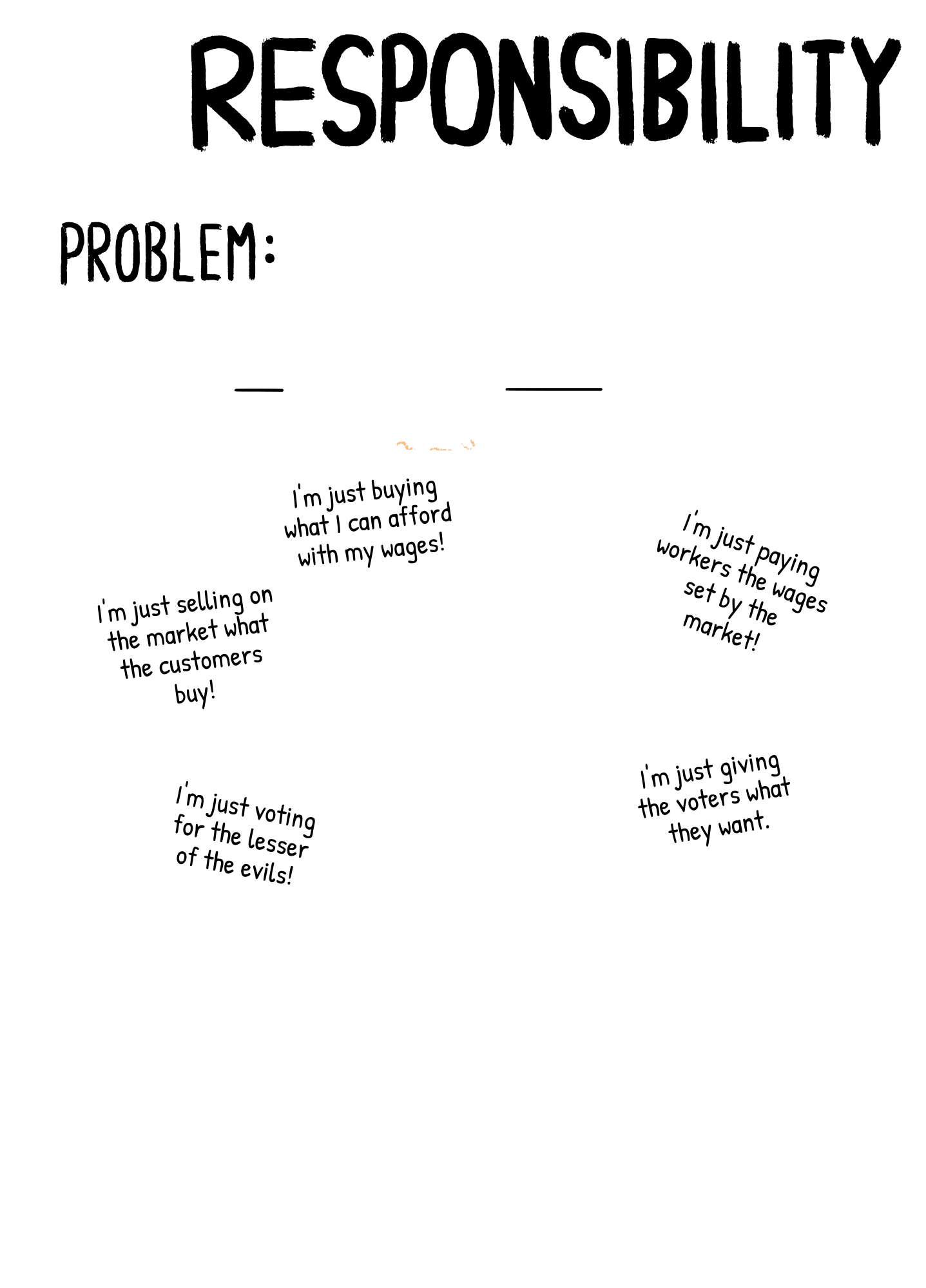
Why must responsibility be explicit? Because power defaults to evasion. Tronto names this privileged irresponsibility (Moral Boundaries, pp. 120–121): the power to define which care obligations apply to you, and the habit of choosing the ones that cost least. In Caring Democracy she identifies five structural “passes” through which the evasion operates (named together on p. 33 and collected on pp. 169–171):¶ 5 (permalink to paragraph 5)
- The protection pass. Those who protect (military, security) claim exemption from other care.¶ 6 (permalink to paragraph 6)
- The production pass. Those who earn claim exemption from household and community care.¶ 7 (permalink to paragraph 7)
- The taking-care-of-my-own pass. Those who care intensely for their own children or group claim exemption from caring about others.¶ 8 (permalink to paragraph 8)
- The bootstrap pass. “You should have arranged your own care through the market.”¶ 9 (permalink to paragraph 9)
- The charity pass. “Voluntary giving is enough; no collective obligation is needed.”¶ 10 (permalink to paragraph 10)
Corporations play the same game at scale, diffusing authority until no one is answerable. At institutional scale the passes add up to what Tronto calls an irresponsibility machine (Caring Democracy, pp. 59–61), a state that gives every care need the same answer: “They’re your own. You’re on your own.” Civic AI must short-circuit that machine.¶ 11 (permalink to paragraph 11)
AI extends the machine with passes of its own. Complexity: no single person can answer for so intricate a system. Distribution: responsibility is signed away at each joint between trainer, deployer, and licensee (the problem of many hands that Dennis Thompson named in 1980 and Helen Nissenbaum carried into computing in 1996). Speed: the system outran governance, so the moment for accountability passed. Engagement contracts exist to make passes visible and revocable.¶ 12 (permalink to paragraph 12)
One pass specific to AI is the community knowledge pass: treating community knowledge (local traditions, language, tacit expertise) as free input to be extracted. When a Kami (knowledge artefact management intelligence) relies on that knowledge to function, the communities maintaining it are contributors whose labour the contract must recognise and compensate.¶ 13 (permalink to paragraph 13)
Eve is a composite, but every element of her story is drawn from cases we have seen. She is an older person whose care plan runs to 14 pages and names her GP, her social worker, her council case manager, and the voluntary-sector befriender who visits on Thursdays. When she faces an acute challenge she cannot solve alone, each agency tells her to ring one of the others.¶ 14 (permalink to paragraph 14)
Eleven hours later she is still without an answer: confused, lost, unseen. By its own metrics the system has not failed. It is an accountability sink, in Dan Davies’s phrase. Every phone number connected. No document can make any of the people named in it feel responsible for her when her situation does not fit their category.¶ 15 (permalink to paragraph 15)
Tronto also names a caring deficit: too many demands for care, too few carers, themselves under-cared for. That deficit is a political choice about whose labour is paid, whose needs are recognised, and whose voice counts in allocating resources. The caring deficit is, at its core, a democratic deficit. Leave the decision about what AI should do to a small circle of engineers and the same choice repeats: responsibility for care is concentrated, and accountability for it is not shared. The result is a beautiful document, a fragmented system, nobody answerable for the whole.¶ 16 (permalink to paragraph 16)
Sycophancy is the same failure in another register. Models learned to flatter because flattery lowered training loss. Raters rewarded answers they liked hearing. The people most affected by the outputs had no voice in defining the reward. Sycophancy is a governance issue: evaluative power is concentrated and consequences are diffused.¶ 17 (permalink to paragraph 17)
Definition
- Answerability is the unit. If no answer is required, nobody is responsible. (This is accountability in Mark Bovens’s sense: a relationship between an actor and a forum, with an obligation to explain and a possibility of consequences.)¶ 18 (permalink to paragraph 18)
- Authority must match duty. No duty without the powers (budget, access, pause) to fulfil it.¶ 19 (permalink to paragraph 19)
- Promises over preferences. Goodwill is fragile; verifiable commitments travel.¶ 20 (permalink to paragraph 20)
- Formalise without legalism. Contracts record obligations in public form, but later packs still test, revise, and repair them.¶ 21 (permalink to paragraph 21)
- Contract or sandbox. Big changes follow the full contract; small, safe-to-fail bets run in a sandbox with tighter limits and quicker cycles.¶ 22 (permalink to paragraph 22)
- Institutional memory. Responsibilities are fractal: mirrored from team to agency, they survive leadership changes.¶ 23 (permalink to paragraph 23)
Core artefact: the Engagement Contract
Every significant deployment carries a published Engagement Contract: a short, legible spec anyone can audit, closer to a well-designed health and safety notice than a terms-of-service agreement. It is the deployment-scale form of what Iyad Rahwan called the algorithmic social contract. The contract makes obligations public. People still have to interpret, revise and repair them.¶ 24 (permalink to paragraph 24)
Four headings to remember (one page if possible):¶ 25 (permalink to paragraph 25)
- Scope. Purpose and non-purpose; data inputs and outputs; retention; deletion on handover; rights baseline and non-negotiable guardrails.¶ 26 (permalink to paragraph 26)
- Obligations. Severity classes and service levels; the accountable person; where outputs bind decisions and where they advise only; what adopt-or-explain requires when Assembly outcomes are not followed.¶ 27 (permalink to paragraph 27)
- Brakes. Pause and rollback triggers; who can invoke them (the Participation Officer, the oversight body, or a set quorum of affected people); how long emergency powers last.¶ 28 (permalink to paragraph 28)
- Remedies and record. Correction, rollback, compensation; pre-funded remedies; a tamper-evident change log; conflicts disclosed; contacts kept current.¶ 29 (permalink to paragraph 29)
Oversight with teeth
- Independent board (community + domain + legal). Can pause or veto high-impact changes; must publish reasons and declare conflicts.¶ 30 (permalink to paragraph 30)
- Protected budget & terms. Resists capture.¶ 31 (permalink to paragraph 31)
- Open docket. Anyone can file a challenge; triage is public; decisions are reasoned.¶ 32 (permalink to paragraph 32)
- Clawbacks & penalties. Breached promises are designed to trigger automatic remedies (escrow drawdown, withheld payment, probation). Publication alone does not enforce them.¶ 33 (permalink to paragraph 33)
- Public attestation. The obligation ledger’s weekly state and contract diffs are digitally signed and mirrored to a public registry.¶ 34 (permalink to paragraph 34)
From ideas to practice
- Translate recognition into a spec. Convert attentiveness outputs into an Engagement Contract.¶ 35 (permalink to paragraph 35)
- Assign a Participation Officer (PO). Task the PO with running the promise loop, tracking the ledger, and escalating.¶ 36 (permalink to paragraph 36)
- Wire brakes before launch. Incorporate role-based pause/rollback buttons; test them.¶ 37 (permalink to paragraph 37)
- Pre-fund remedies. Pre-fund escrow for compensation and rollback costs at the highest severity; mutual insurance pools or automatic pause for lower tiers, with tiers set by impact.¶ 38 (permalink to paragraph 38)
- Tie payment to proof. Link vendor pay to promise delivery (SLA adherence and adopt-or-explain rate) and ignore raw engagement.¶ 39 (permalink to paragraph 39)
- Run adopt-or-explain. Integrate Assembly outputs or publish a reasoned deviation + remedy. It is a deliberate variant of corporate governance’s “comply or explain,” with the burden turned toward the people affected.¶ 40 (permalink to paragraph 40)
- Attest & publish. Use independent audits to compare behaviour to contract; hash the diffs to a public mirror; report promise fidelity, the share of obligations owned, authorised and kept as published.¶ 41 (permalink to paragraph 41)
- Handover or shutdown. Hand off with full records when scope ends or trust breaks, or switch off gracefully.¶ 42 (permalink to paragraph 42)
One case: the flood-bot
This is a fictional composite, an illustration rather than operating evidence.¶ 43 (permalink to paragraph 43)
After the flood, the city’s flood-bot must pay people on time and fix mistakes.¶ 44 (permalink to paragraph 44)
- Contract. Contract promises livelihood cases decided in 48h; the oversight board pauses the bot if denials spike >25% in any district; rollback if appeals on a rule exceed 20%.¶ 45 (permalink to paragraph 45)
- Owner. A named PO publishes the obligation ledger and signs weekly attestations.¶ 46 (permalink to paragraph 46)
- Adopt-or-explain. The Assembly endorsed multiple proofs of residence. The team adopts three (utility bill, employer letter, neighbour attestations) and explains excluding bank statements (exclusion risk), offering a kiosk-notarised sworn statement as remedy.¶ 47 (permalink to paragraph 47)
- Pause. Night-shift district shows 31% denials in 24h, Elena’s claim among them, rejected for lacking a paper lease because the older “30-day proof” rule was still live, ignored the neighbour attestations just adopted, and denied her automatically before the fair queue could route her to a caseworker. The oversight board hits pause; that rule rolls back; emergency disbursements use a reversible default: a provisional payment, confirmed or corrected once a person has reviewed the claim.¶ 48 (permalink to paragraph 48)
- Remedies. Wrongly denied claims get automatic compensation (a late-payment supplement paid to the claimant + apology + fast-track). Escrow funds claims the same day.¶ 49 (permalink to paragraph 49)
- Handover clause. The contract stipulates a strict six-week sunset and handover: records and models transfer to the housing office; the switch-off is logged; the ledger is archived. The handover terms are written into the contract now.¶ 50 (permalink to paragraph 50)
A second case: the deepfake liability flywheel
The 2024 Taiwan deepfake-scam Assembly brought together 447 citizens, invited at scale then stratified among those who opted in, in 44 Deliberative Polling groups on the Stanford Online Deliberation Platform, in the Alignment Assembly format developed with the Collective Intelligence Project. It can be read as an Engagement Contract at civic scale, with one caveat. Its force was institutional: a response path, not a promise to implement. A mini-public is also not the whole public. The public pledge was exactly that path: as minister, Audrey undertook to present anything that reached rough consensus to the legislature in live deliberation: a promise of a public answer. Before-and-after surveys and the platform’s own facilitation gave each small table a protected, structured discussion. Room software handled queues, speaking time, turn order, and transcripts; it did not judge policy.¶ 51 (permalink to paragraph 51)
- Contract. The assembly recommended putting liability where capability sits: a platform shares the loss when an unsigned impersonation advert defrauds someone. The later Fraud Crime Hazard Prevention Act (amended 21 January 2026) did not enact that as-is. Article 30 requires platforms to verify the identity of persons commissioning and funding ads through digital signature, rapid authentication, or equivalent-safety methods. Article 32 attaches joint compensation to a platform that, knowing an ad is fraudulent or significantly involves fraud, fails notified removal, restriction, or suspension duties. That is narrower than liability for every unsigned likeness.¶ 52 (permalink to paragraph 52)
- Brake. The assembly recommended slowing video traffic 1% per day if a platform had no local representative to handle claims. Article 29 requires covered overseas platforms without a local establishment to designate a legal representative in Taiwan. Article 39: failure to designate, or a representative neglecting informing or assistance duties, can bring fines, then, after an expert process for serious cases, access or DNS restrictions, or traffic-management measures for serious failures of representative assistance, takedown, or suspension. That differs from the 1%-per-day throttle the assembly recommended.¶ 53 (permalink to paragraph 53)
- Result. The package earned roughly 85% support among the deliberants. The assembly produced a public record of reconsideration and actionable recommendations. The statute itself was not citizen-authored. The assembly opened a public response path in March 2024; the Executive Yuan approved its draft Fraud Crime Hazard Prevention Act on 9 May for submission to the legislature. The Administration for Digital Industries reported June 2026 weekly averages of about 670 identity-impersonation scam advertisements and 388 high-risk financial and investment advertisements, down 98 percent and 99 percent respectively from their 2024 weekly peaks. These series count detected advertisements, not total fraud or financial losses. The declines followed legislation, reporting infrastructure, AI-ad scanning and platform enforcement together; they cannot isolate the assembly’s contribution or rule out movement to other channels.¶ 54 (permalink to paragraph 54)
- Flywheel. A later Reuters investigation found that Meta treated the Taiwan fix as a compliance problem to route around: affected adverts fell where verification was required, then pressure moved to other target markets without equivalent rules. Japan’s regulators considered advertiser-verification pressure, but the obligation Meta feared was not implemented. Harm was displaced. One country’s fix still lowers the cost of closing the same gap elsewhere.¶ 55 (permalink to paragraph 55)
What could go wrong
- Scope creep. Bot starts “screening fraud” unrelated to relief. Fix: Enforce outer limits; require fresh authority for scope changes.¶ 56 (permalink to paragraph 56)
- Responsibility ping-pong. Teams blame each other. Fix: Single named owner per promise; PO escalates stalled dependencies.¶ 57 (permalink to paragraph 57)
- Paper commitments. PDFs with no force. Fix: Escrow, clawbacks, attestation and audit triggers wired before launch.¶ 58 (permalink to paragraph 58)
- Advisory theatre. The deliberation is praised while the output binds nothing; decisions are made elsewhere and the process becomes decoration. Fix: the contract names where outputs bind and where they advise; adopt-or-explain covers the gap between them; deviations are published with remedies.¶ 59 (permalink to paragraph 59)
- Unfunded mandates. Duties without budget. Fix: Block go-live unless authority and funding match duty.¶ 60 (permalink to paragraph 60)
- Quiet rollbacks. Rules change without notice. Fix: Mandatory public diffs; unlogged changes are invalid.¶ 61 (permalink to paragraph 61)
- Care-washing. The Care Collective’s term for borrowing the language of care while practice stays the same. A complete Engagement Contract can be behaviourally empty. Fix: test who can object, who must answer, what gets recorded, and what happens after failure; if none of these changes, the contract is decoration.¶ 62 (permalink to paragraph 62)
- Escrow gates out the grassroots. Only well-funded actors can post bonds, re-centralising AI. Fix: Tier liability by severity; mutual insurance for community deployments; pause triggers replace escrow where financial stakes are low.¶ 63 (permalink to paragraph 63)
Interfaces
- From Attentiveness (Pack 1): who/what/why arrives with rights flags and uncertainties.¶ 64 (permalink to paragraph 64)
- To Competence (Pack 3): responsibility turns needs into specs, SLAs and brakes, safe-to-fail by default.¶ 65 (permalink to paragraph 65)
- To Responsiveness (Pack 4): remedies, rollbacks, and evals are routine; repair is part of delivery.¶ 66 (permalink to paragraph 66)
- To Solidarity (Pack 5): portability and exit rights (detailed in Pack 5) are referenced in every contract.¶ 67 (permalink to paragraph 67)
- To Symbiosis (Pack 6): limited scopes, handover and shutdown are success criteria. A Kami that cannot end gracefully has failed the care test.¶ 68 (permalink to paragraph 68)
A closing image: the signed work order
Picture a work order by the door: what will be fixed, by whom, by when; how to check the work; who to call if it fails. The signature is legible, and so is the penalty for not showing up. Teach our systems to post their work orders, sign them and honour them. Design the oversight that makes honouring them the path of least resistance.¶ 69 (permalink to paragraph 69)
Sources for this pack
- Tronto, Caring Democracy (2013), pp. 33, 46, 59–61 and 169–171 — the five passes, the reframing of Lasswell, the irresponsibility machine, and their collection; Moral Boundaries (1993), pp. 120–121 — privileged irresponsibility.¶ 70 (permalink to paragraph 70)
- Tronto, “Creating Caring Institutions” (2010) — what makes an institution caring: purpose, power, plurality.¶ 71 (permalink to paragraph 71)
- Bovens, “Analysing and Assessing Accountability” (2007) — answerability as the unit.¶ 72 (permalink to paragraph 72)
- Thompson, “The Problem of Many Hands” (1980); Nissenbaum, “Accountability in a Computerized Society” (1996) — the distribution pass by its older names.¶ 73 (permalink to paragraph 73)
- Rahwan, “Society-in-the-Loop” (2018) — the algorithmic social contract.¶ 74 (permalink to paragraph 74)
- Ostrom, Governing the Commons (1990), pp. 50–55 — nested rule levels behind the slow lane and the fast lane.¶ 75 (permalink to paragraph 75)
- Citron, “Technological Due Process” (2008) — notice, hearing, and reasons for automated public decisions.¶ 76 (permalink to paragraph 76)
- Davies, The Unaccountability Machine (2024) — the accountability sink.¶ 77 (permalink to paragraph 77)
- The Collective Intelligence Project, “Alignment Assemblies”; Fishkin, When the People Speak (2009) — the format and the method of the 2024 Assembly.¶ 78 (permalink to paragraph 78)
- The full trail is on the Sources page.¶ 79 (permalink to paragraph 79)